

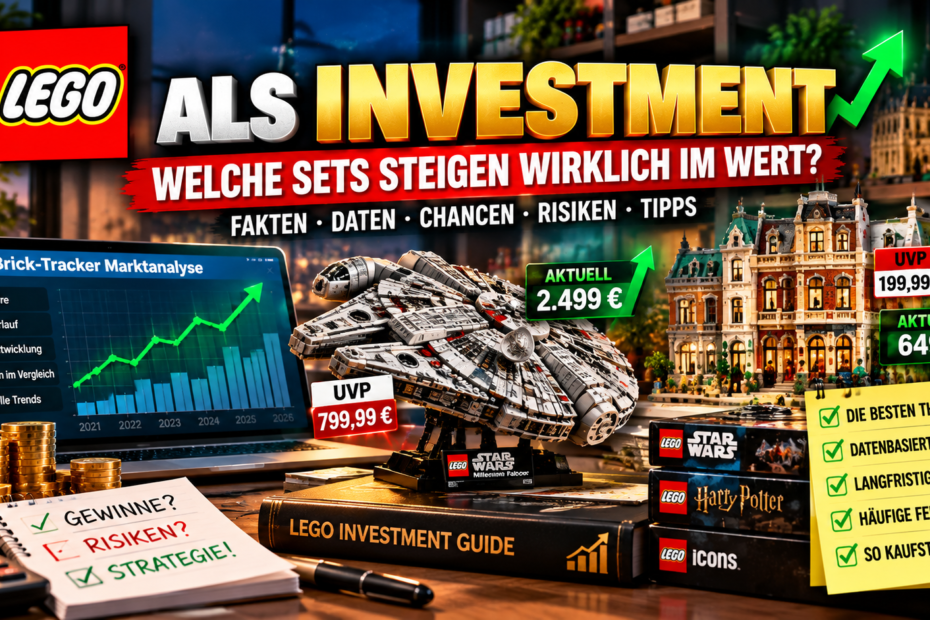
LEGO as an Investment: Buy a sealed set, store it for a few years, and sell it later at a profit—the idea sounds that simple. But which LEGO sets actually increase in value? And when does a rising retail price actually become a profitable business? The answer doesn’t start with the most expensive collector’s set, but rather with the purchase price, demand, and a realistic look at the costs.
Brick-Tracker continuously analyzes retailer prices. With the LEGO Market Analysis, you can compare EOL sets, theme lines, and price trends. This guide explains how to make the most of the data—and why a high percentage alone doesn’t necessarily indicate a good Investment.
Data as of the following examples: Brick-Tracker snapshot submitted on October 16, 2026; not live prices. EOL years may be projections. The figures represent Seller asking prices and are not verified resale proceeds on the secondary market.
Is LEGO a good investment?
LEGO is a physical collectible and not a traditional investment. Once a set is no longer in production, some may be sold at significantly higher prices, while others remain well below their original MSRP for a long time. Key factors include the popularity of the theme, set size, exclusivity, availability, the condition of the packaging, and how many other collectors have stockpiled the same set.
It’s especially important to note that a retail price of 300 euros does not automatically mean that a private seller will receive 300 euros today. The sales channel, fees, shipping, taxes, and Buyers’ actual willingness to pay can significantly affect the net proceeds.
Check out my YouTube channel for more insights
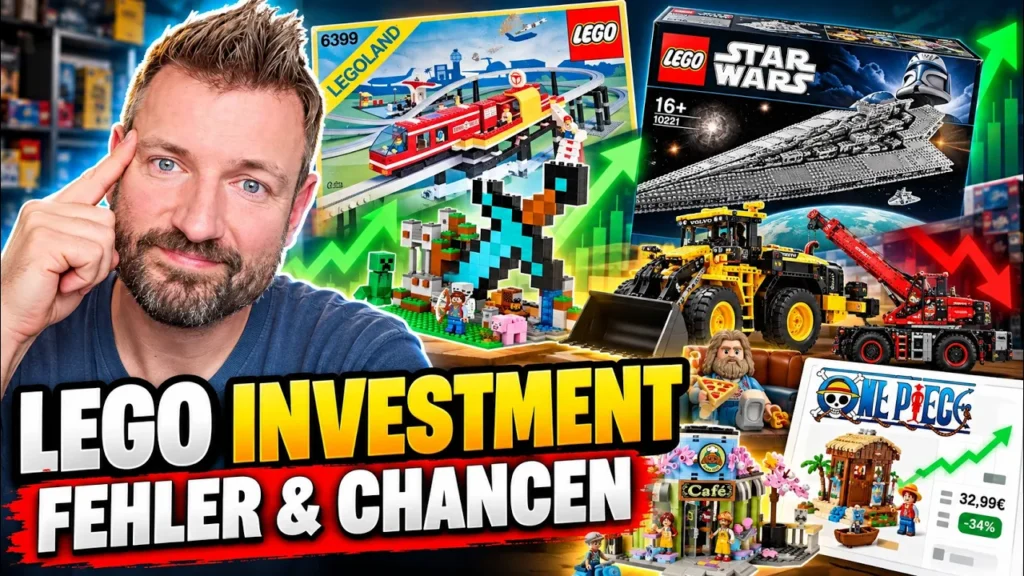
I also talk about my experiences with City, Minecraft, Star Wars, bad buys, and specific investment decisions on the Brick-Tracker YouTube channel. My video “LEGO Investment: My Biggest Mistakes, Lessons Learned, and Opportunities” is particularly relevant to this guide . It covers not only successful sets but also what I would do differently today.
Which LEGO sets are already showing noticeable price fluctuations?
In a filtered analysis for the EOL year 2026, 45 recorded sets were above their MSRP; 26 of these had increased in price during the 180-day window under consideration. This is a selection using the active filter “Currently Above MSRP” and does not indicate how many of all EOL-2026 sets are profitable. The following examples deliberately showcase different product categories and price ranges.
| Set | MSRP | Recorded Price | Difference from MSRP |
|---|---|---|---|
| 71439 – Adventures with the interactive LEGO Mario | €49.99 | €78.90 | +57.8% |
| 76435 – Hogwarts Castle: The Great Hall | 199.99 € | 289.99 € | +45.0% |
| 31208 – Hokusai – The Great Wave | 99.99 € | 129.86 € | +29.9% |
| 76328 – Batman: Batmobile from the 1960s TV series | €149.99 | 219.99 € | +46.7% |
| 76417 – Gringotts Wizard Bank – Collector’s Edition | €429.99 | 539.99 € | +25.6% |
| 77092 – Deku Tree 2-in-1 | 299.99 € | 324.90 € | +8.3% |
What the examples show: The Great Hall, the Batmobile, and Hokusai’s *The Great Wave* are clearly priced above their MSRP based on the recorded retailer prices. This is interesting from a market observation perspective, but it does not prove that anyone who purchased these items at the MSRP has already made a corresponding profit. For bargain or rare deals, the difference between the list price and the actual selling price can be particularly large.
With LEGO Super Mario, the percentage difference is particularly striking. With high-priced collector’s sets like Gringotts, on the other hand, the absolute amount of capital tied up is significantly greater. That’s why it’s always worth looking at the euro amounts, percentages, number of offers, and Price History all at once.
Shopping Makes the Difference: Why a 35 to 38 Percent Discount Can Be So Important
A key Brick-Tracker shopping rule is this: For many sets that are regularly discounted, it’s only worth taking a closer look once the price drops to about 35 to 38 percent below the MSRP. This is a strategy based on experience—not a universal buying rule or a guarantee. For exclusive sets, free gifts, or particularly scarce items, different criteria may be appropriate.
Here’s a simple example: A set has a MSRP of 200 euros. With a 35 percent discount, the purchase price is 130 euros; with a 38 percent discount, it’s 124 euros. On the other hand, someone who pays 200 euros will have to generate significantly higher demand later on just to cover the fees and shipping costs.
Sample calculation: 200 euros MSRP, 130 euros cost price
| Position | Amount |
|---|---|
| Shopping | 130.00 € |
| Future selling price (estimated) | 220.00 € |
| Sales commission (assumed to be 10%) | −22.00 € |
| Shipping and Packaging (Accepted) | −8.00 € |
| Profit before other expenses and taxes | 60.00 € |
That would amount to about 46 percent of the purchase price— before factoring in storage costs, tied-up capital, potential returns, damage, and applicable taxes. If the item is held for several years, the annual return is lower than this one-time total rate. In retail, other sales tax and operating costs may also apply.
Why a set doesn’t automatically increase after EOL
“End of Life” (EOL) means that a set is being phased out of the regular product line or is scheduled to be. This can lead to a long-term shortage of supply. However, it does not guarantee an immediate price spike or a sustained increase. Large remaining inventories, successor items with similar designs, weak demand, or high inventory levels among resellers can keep prices low for a long time.
Especially in the year an EOL is expected, a set may already be priced above the MSRP at one Seller, while other stores may still be selling remaining stock at a lower price. Furthermore, an EOL forecast is not the same as a confirmed discontinuation of production. Before making a purchase, you should check availability and Price History again.
Which LEGO themes are suitable for analysis?
The most important insight from ongoing monitoring: Not every well-known theme set is automatically a good investment. Using the Brick-Tracker market analysis, you can evaluate the EOL years from past years, broken down by theme set, price trends, and deviation from the MSRP. The following assessments are based on my own experience and observations; they are not a statistically verified ranking of returns.
LEGO Star Wars: Name recognition alone is no longer enough
Star Wars is a massive brand, but when I look at the more recent EOL releases, I notice that relatively few sets from the last two years have risen above their MSRP. That’s why I consider the old rule of thumb—“Buy Star Wars and let it sit”—to be outdated. That doesn’t mean no Star Wars set can appreciate in value anymore: Individual models can still be worth considering, but purchase price, competing models, production run, and a very long holding period play a much bigger role. Market analysis here should also specifically highlight the sets that haven’t yet exceeded their MSRP, rather than just filtering out the winners.
LEGO Harry Potter: Demand is there—but keep reissues in mind
Harry Potter remains an interesting market because the settings and characters continue to attract new buyers. However, when it comes to Hogwarts variants and other well-known themes, it’s important to carefully assess how similar current and upcoming sets are. The prices for 76435 and 76417 recorded in our snapshot provide good opportunities for analysis, but they aren’t automatic proof of achievable sales profits.
LEGO City: Vehicles, Construction Sites, and Real Demand from LEGO Cities
For me, City is one of the most exciting lines. Many people build their own LEGO cities and need the right vehicles, construction site models, and emergency response models to go with them. A special vehicle or a well-designed construction vehicle in a popular color can be harder to find once it’s discontinued. I also specifically look for licensed or uniquely designed vehicles. The key factor is whether the model remains in demand among collectors and in the world of play.
Smaller city sets, in particular, illustrate why I look at profits in terms of percentages: Buying a set for 19 euros and later selling it for 40 euros initially results in a 21-euro difference—that is, a gross profit of about 110.5 percent relative to the purchase price. If, for example, 5.80 euros are incurred for sales fees, packaging, and other direct costs, and the buyer pays for shipping separately, a surplus of 15.20 euros remains. That corresponds to 80 percent of the purchase price —before factoring in storage costs, taxes, and the value of my own labor. For ten identical sets, that would amount to 152 euros; for 50 sets, 760 euros; and for 100 sets, 1,520 euros. However, scaling up also increases storage requirements, labor costs, and the risk of not being able to sell all units at the expected price.
LEGO Creator: View standalone models separately from City
The Creator series—and especially the Creator 3-in-1—are also of interest to me, but I wouldn’t lump their results together with those of the City series. The target audiences and use cases are different. Using the topic filter, you can see which Creator models remain competitive after EOL and which ones only see a short-term price increase.
LEGO Minecraft: Strong Demand from the Younger Target Audience
Based on my own sales and tests, Minecraft is a themed world that works particularly well. Kids are familiar with the characters, worlds, and building ideas, and they often ask for specific sets. For me, that’s a reason to regularly check out Minecraft when making new purchases. Still, the same rule applies here: Not every Minecraft set is automatically a winner; you have to monitor the performance of each model individually, keeping an eye on the Price History and retailer offers.
LEGO Friends: An interesting area for further testing
Friends hasn’t been one of my main investment focuses so far. However, I spoke with another collector who, by his own account, has achieved good returns there. That’s an interesting point, but it’s not yet solid evidence for the entire series. That’s precisely why a separate analysis of Friends spanning several EOL years—highlighting both winners and losers—is worthwhile.
LEGO Icons, Ideas, and Art: A Detailed Comparison of Collector’s Sets
Display models often appeal to adults, but they tend to be more capital-intensive and require more storage space. For art-themed sets like 31208, you should examine actual sales trends as well as the number of available Sellers and potential alternatives. The theme alone is no guarantee of a return on investment.
Why a 20-euro profit can be a lot—and why percentages alone aren’t enough
With small sets, the absolute profit is often underestimated. A profit of 15 or 20 euros may sound unremarkable, but with a purchase price of 19 or 20 euros, it can represent a very high overall return in percentage terms. This is an important distinction from an analysis that focuses solely on the euro amount.
As a rough comparison, a broadly diversified stock index such as the MSCI World is often assumed to yield a long-term average return of about seven percent per year. This is neither a fixed nor a guaranteed return. Above all, an 80 percent profit from selling LEGO over several years should not be directly compared to a seven percent annual stock return: An 80 percent total return over four years translates to approximately 15.8 percent on an annualized basis, before factoring in time spent, taxes, and other costs. An ETF is also easier to trade and does not require physical storage, whereas LEGO prices and sales can be more volatile and less liquid.
That’s why I look at both: How many euros are actually left after all costs are deducted? And how large is this surplus relative to the capital invested and the holding period? Only this combination makes it possible to meaningfully compare different sets.
Here’s how to identify meaningful trends with the Brick-Tracker market analysis
- Select an EOL year: Start with 2026 and then move on to earlier years. This will let you see how sets perform based on their planned or actual end-of-life dates.
- Set up the analysis: Compare “Currently Above MSRP” and “Currently Below MSRP” separately. Looking only at the winners creates a distorted picture.
- Vary the time period: Use 14, 30, 90, 180, and 365 days. A short-term price spike does not automatically indicate a long-term trend.
- Filter by theme and price range: Compare similar sets. A small polybag and a 500-euro collector’s model have completely different cost structures.
- View Price History: Check whether the increase is steady or the result of isolated supply gaps and outliers.
- Consider the number of sellers: A high price from only one seller is a weaker signal than a market that has remained stable over a longer period with multiple Deals.
The analysis uses stored retailer prices; Amazon prices are not included in the historical Brick-Tracker Price History. It therefore shows observable list prices, but not a complete statistical overview of all actual sales. You can open the LEGO market analysis here.
Backtracking: What Past EOL Cohorts Reveal About New Purchases
Instead of focusing solely on current candidates, it’s worth taking a look back: Which items from previous EOL years are in high demand today? Which sets are still below MSRP despite being retired? And how quickly did a potential price increase take effect? Market analysis allows for this comparison across multiple years. Hypotheses can be derived from historical patterns—but not definitive predictions.
For a fair comparison, sets that haven’t gone up in value should also be taken into account whenever possible. If you select only the most spectacular winners, you systematically overestimate the odds.
When to Shop? Why Black Friday Isn’t the Only Good Time
In the retail sector, stores are constantly competing with automated price adjustments, coupons, in-store promotions, and limited-time discounts. Based on Brick-Tracker’s daily monitoring, practical experience shows that attractive deals can appear throughout the year—sometimes at intervals of just a few weeks. The often-cited timeframe of about six weeks is an observation, not a statistically proven pattern.
If you wait until Black Friday, you might miss out on a best price you could have gotten earlier. It makes more sense to set a target price for the items you want and keep an eye on the market: Top Deals, Live Deals, and the Brick-Tracker app with Price Alerts can help you do that.
The Most Common Mistakes in LEGO Investment
- Buying at the wrong price: A popular set isn’t automatically a good Investment if it’s too expensive to start with.
- Confusing MSRP with market value: The list price is not a guaranteed resale value.
- Consider only winners: An analysis must also take into account stagnant and declining sets.
- Ignore fees and taxes: What matters is the amount left over after all costs have been deducted.
- Tying up capital for too long: Storage space, damaged boxes, and slow-moving inventory cost money.
- Blindly trusting EOL rumors: End-of-life dates can change; what matters is actual availability.
- Putting all your eggs in one basket: Demand can change; a broad selection reduces individual risks, but does not eliminate them.
You can find more specific examples and personal lessons learned in my video, “LEGO Investment: My Biggest Mistakes, Experiences, and Opportunities.”
Document Collection and Purchase Prices
If you’re storing multiple sets, you should keep track of the purchase date, purchase price, quantity, condition, storage location, and future selling price. The Brick-Tracker Investment Tool is a useful starting point for this. Combined with Price Comparisons and market analysis, it becomes clear which sets should be monitored and where your own calculations may need to be adjusted.
Conclusion: It’s not the highest price that wins, but the best entry point.
LEGO sets can increase in value as collectibles—but they don’t have to. The most important question, therefore, isn’t “Which set is particularly expensive today?” but rather “At what price could I have bought it, what is a realistic level of demand, and what profit will I make when I sell it?” Those who work with historical data, factor in risks, and don’t chase every EOL rumor make more informed decisions.
Compare for yourself now: Start a market analysis, read the 2026 LEGO EOL list, and keep an eye on matching sets via Brick-Tracker.
Frequently Asked Questions About LEGO as an Investment
Which LEGO sets increase in value the most?
There’s no reliable way to predict this. Individual collector’s models and popular themes may see their EOL prices rise, while others may remain stagnant. A look at several years’ worth of EOL data—including the underperformers—is more informative than a simple “top list.”
How much of a discount should I aim for when making a purchase as a buyer?
For many sets that are regularly discounted, Brick-Tracker often considers prices 35 to 38 percent below the MSRP to be a good starting point. However, the right entry price always depends on the specific set and its risks.
How long do I need to store LEGO?
There is no set holding period. Demand, remaining inventory, and competing offers determine when it makes sense to sell. Holding onto inventory for a longer period can result in additional storage costs.
Is a price above the MSRP already a profit?
No. The current seller’s asking price is not the same as the seller’s net sales proceeds. The actual sales price, the original purchase price, and all associated costs are the determining factors.
Where can I check LEGO’s performance?
The Brick-Tracker market analysis allows you to compare EOL years, categories, price ranges, and price trends across different time periods.
Note: This article is for informational purposes only and does not constitute investment or tax advice. Prices and EOL classifications are subject to change. The linked Brick-Tracker tools provide dealer pricing and historical data, not guaranteed resale prices.