

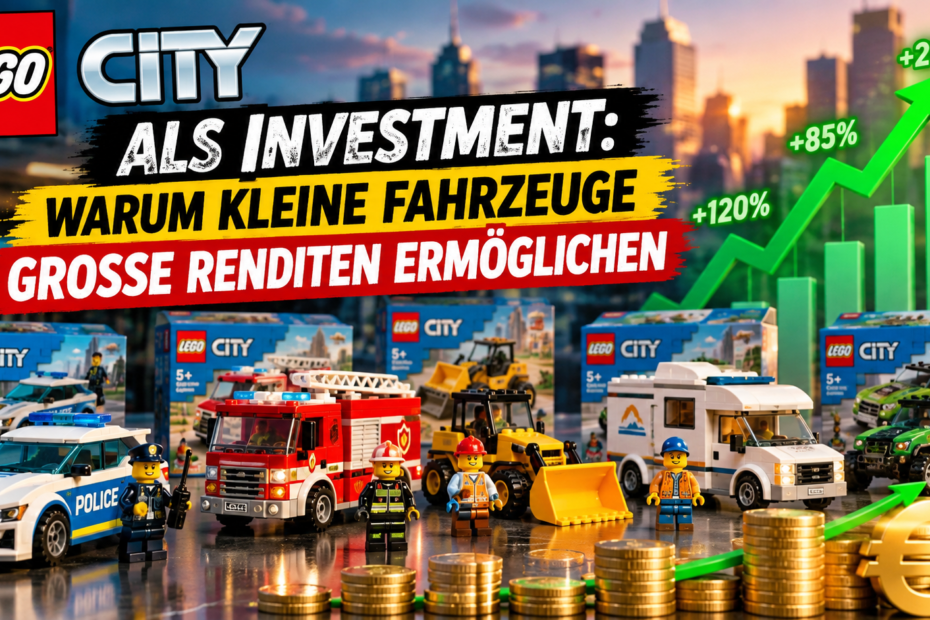
At first glance, LEGO City seems unspectacular: fire trucks, excavators, tow trucks, and police vehicles are on the shelves every year. But that’s precisely what makes it an interesting concept. Children build entire cities and need the right vehicles, while older models may disappear from regular retail stores once they’re discontinued.
In my videos, I often mention that when it comes to LEGO City, I look for vehicles, construction vehicles, harmonious color schemes, and recognizable functions. That’s no guarantee, though. But the starting price for small sets is often low enough to make even modest absolute profits attractive in percentage terms.
Why City Vehicles Are Always in Demand
A single large collector’s model needs to find a Buyer with a substantial budget. A small city vehicle appeals to a different target audience: parents, children, city builders, and fans of specific vehicles. A suitable excavator or fire truck can be integrated into existing LEGO cities. Demand, therefore, does not come exclusively from collectors who put sealed boxes on their shelves.
I find construction and utility vehicles with clearly recognizable functions particularly exciting. A license plate or unusual design can be an added bonus. Color also plays a role: A vehicle that looks realistic and fits in with other city models may be more sought after than one with an unusual color scheme.
19 euros in purchases, 40 euros in sales: What’s really left?
Here’s a practical example: You buy a City Set for 19 euros and later sell it for 40 euros. The gross difference is 21 euros. Based on the 19-euro purchase price, that’s 110.5 percent—but not yet a net profit. If we assume a total of 5.80 euros for platform fees, packaging, and other direct costs, that leaves 15.20 euros—or exactly 80 percent of the purchase price—before additional costs and taxes.
In this example, ten identical sales result in a profit of 152 euros, 50 sales in 760 euros, and 100 sales in 1,520 euros. However, this also involves 100 instances of inspection, inventory management, sales processing, and potential customer inquiries. Scaling only works if demand and the sales period align.
What Our Own Data Shows—and What It Doesn’t
The City Stadtzentrum 60380 is a striking example in the market analysis provided. It is listed at a dealer price of 349.99 euros, compared to a MSRP of 209.99 euros. The 66.7 percent difference from the MSRP indicates a substantial markup, but does not guarantee a realizable return. An older best price or the number of sellers can significantly alter this picture.
I had already published a separate article about my personal investment choices regarding the City Bulldozer 60466. Such case studies are particularly valuable when an actual selling price is added later: Only then can a genuine, transparent return history be told.
Mistakes I’d Avoid at City
Not every City Set becomes scarce. Some vehicles keep reappearing in similar forms. If you buy too close to the MSRP, you’re giving up your safety margin. Even large quantities are risky if sales are slower than expected.
That’s why I would test out different vehicles, keep track of the prices, and only purchase larger quantities after gaining real-world sales experience. A good investment in the city isn’t the set with the most hype, but the model where demand, purchase price, and fulfillment all align.
City Examples from Data and Real-World Experience
| Set | EOL Information | MSRP | Dealer Price | vs. MSRP |
|---|---|---|---|---|
| 60380 – City Center | 2024 | €209.99 | 349.99 € | +66.7% |
| 60466 – City Yellow Bulldozer | 2026 | 59.99 € | – | – |
| 60420 – City Crawler Excavator | 2025 | – | – | – |
| 60413 – City Fire Department Airplane | – | – | – | – |
Data as of: Brick-Tracker snapshot from October 16, 2026. Prices are based on recorded retailer listings, not verified proceeds from private sales. EOL information may be based on projections.
Here’s how to test the hypothesis using the Brick-Tracker market analysis
Open the Brick-Tracker market analysis, first select an EOL year, and then choose the appropriate theme category. Check not only the sorting by percentage increase, but also “Currently Above MSRP” and “Currently Below MSRP.” It’s precisely these counterexamples that prevent a few spectacular sets from becoming a false rule for the entire theme line.
Then compare prices over 90, 180, and 365 days, provided that data is available for the product set. A short-term increase can also result from the disappearance of low-priced retailer offers. The last recorded price on or before the reference date serves as a basis for comparison, not a guaranteed selling price. Amazon prices are not included in the Brick-Tracker Price History.
For each individual set, check the number of sellers and the Price History. A high asking price from just one seller is less reliable than several comparable deals. To accurately assess the return on investment, you must also take into account the purchase price, fees, shipping, storage, and holding period.
Frequently Asked Questions
Are small LEGO City sets better investments than large sets?
Not necessarily. Small sets can be attractive in terms of profit margin, but they require more processing work per item. Large sets tie up more capital and often take longer to sell.
Why is the percentage return important?
Because a 15-euro profit on a 19-euro purchase yields a different return on investment than a 15-euro profit on a 200-euro purchase. However, the holding period and all costs must still be taken into account.
Should I buy LEGO City right before it reaches EOL?
Not automatically. The key factor is whether the current price is attractive relative to the historical Price History and demand.
More Brick-Tracker Articles
These analyses and background information complement this article. They help put individual examples into context in relation to overall market trends and practical experience.
- Real-World Example: LEGO City Crawler Excavator and Return on Investment
- Which LEGO theme lines are performing particularly well?
- LEGO EOL List 2026
- Brick-Tracker Investment Tool
Next Step: Data Instead of Gut Feelings
On Brick-Tracker, you’ll find the latest Deals, Price Comparisons, and ways to keep track of the sets you want. If you don’t want to search for them yourself all the time, you can set up a personalized Price Alert. It’s also worth checking out the Top Deals section to stay up to date on current price changes.
I discuss additional practical experiences, bad purchases, and strategies on the Brick-Tracker YouTube channel. My video “LEGO Investment: My Biggest Mistakes, Experiences, and Opportunities” is particularly relevant . The analyses are intended to encourage you to do your own calculations, not to blindly follow my purchases.