

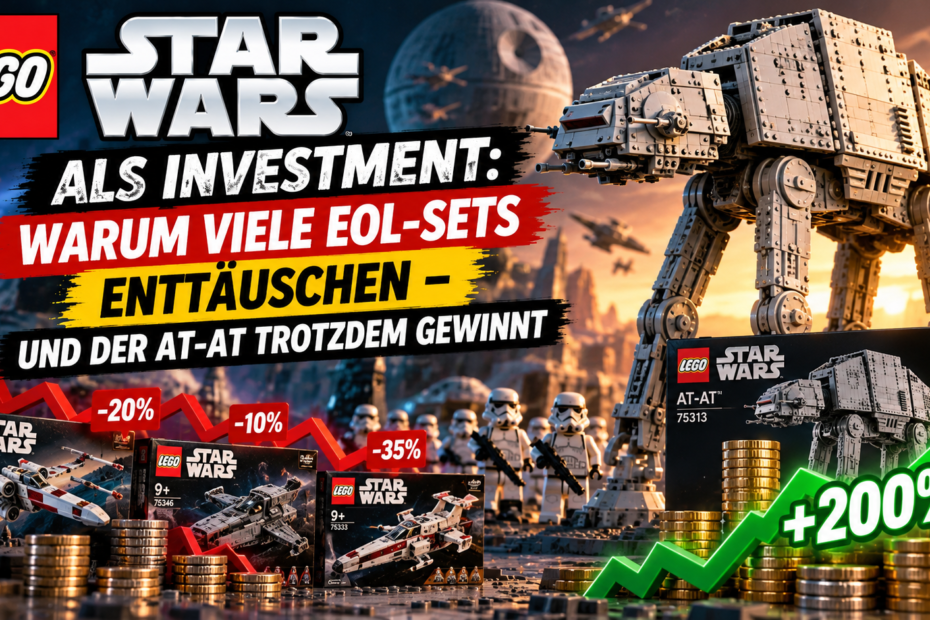
For years, LEGO Star Wars has been considered one of the most popular themes among collectors and investors. But is it still worth making an Investment today? If you only look at the spectacular UCS models, you might think that almost every set automatically increases in value once production ends. My experience and the analyses on Brick-Tracker paint a much more nuanced picture: Especially among the more recent EOL releases, there are many sets that are currently not selling for more than their original MSRP. At the same time, there are some real outliers on the high end.
For me, this is one of the most important insights from the Brick-Tracker market analysis: It’s not just the biggest winners that are interesting. What matters is how many sets within a theme actually win people over—and how many don’t.
The Myth: LEGO Star Wars automatically levels up after EOL
In the past, some Star Wars sets became highly sought-after collector’s items after production ended. This led many buyers to expect that this trend would carry over to new sets. However, Star Wars is now a very broad product line: small Battle Packs, playsets, helmets, dioramas, spaceships, and large UCS models appeal to different buyers. Their value appreciation varies accordingly.
My central thesis is therefore this: LEGO Star Wars is not a surefire success. The 2024 and 2025 EOL lines, in particular, should not be judged based on just a few successful models. I will not publish a complete success rate until all relevant sets have been analyzed using identical filters. The data export available so far covers various themes and price ranges and would be unsuitable for determining an accurate Star Wars success rate.
The UCS AT-AT shows that exceptional increases in value are still possible
The UCS AT-AT 75313 is a particularly good counterexample to the claim that Star Wars just doesn’t work anymore. For the model with a MSRP of 849.99 euros, the Brick-Tracker market overview recorded a retailer’s asking price of 1 ,350 euros on October 16, 2026. That’s about 58.8 percent above the MSRP.
That’s impressive. But it’s not the return on investment for a buyer who purchased the set at a discount, for example, nor is it a documented actual selling price. The key factors are the purchase price, the achievable sales proceeds, fees, shipping, and storage duration. The Price Comparison for the AT-AT 75313 shows the current status.
The AT-AT illustrates one thing above all else: Large, iconic collector’s items can be in high demand after EOL. However, it does not prove that the entire Star Wars merchandise line is performing equally well.
Why the 2024 and 2025 EOL cohorts are so insightful
Anyone who wants to understand the trends of the past two years should first select the “Star Wars” theme in the market analysis and examine the EOL years 2024 and 2025 separately. Next, count not only the sets priced above MSRP but also those priced below MSRP. Only by examining the ratio of these two groups can you determine whether the market as a whole is strong or is driven by a few top-selling products.
The analysis should, if possible, include all standard sets from a given year, not just those priced at 200 euros or more. Otherwise, Battle Packs and smaller play sets will be excluded from the analysis. To ensure a reliable rate, the analysis must also include the reference date and the number of sets for which no retailer price is available.
What I find remarkable about this is that when many Star Wars sets are still priced below MSRP after their EOL, it contradicts the widespread belief that the end of production automatically triggers a price spike. At the same time, one shouldn’t conclude from this that every buyer incurs a loss. Anyone who received a 35 or 38 percent discount at the time of purchase can still make a profit even if they later sell the set for less than the MSRP.
The Comparison with LEGO Technic: Even Big Names Offer No Protection
A look beyond Star Wars shows just how well individual sets can perform. The LEGO Technic Mercedes-Benz Zetros 42129 was listed in this data extract with a retailer price of 219 euros, compared to an MSRP of 329.99 euros—about 33.6 percent below the MSRP, even though 2023 was listed as the EOL year.
The comparison between the AT-AT and the Zetros is deliberately exaggerated. They belong to different thematic categories, price ranges, and target audiences. But both examples illustrate why “large set,” “well-known license,” or “already EOL” are not investment strategies in and of themselves.
The calculation starts with the purchase price—not the MSRP
Here’s an example: A set has a MSRP of 100 euros. I buy it at a 38 percent discount for 62 euros. After EOL, I can sell it for 90 euros. The selling price is thus 10 percent below the MSRP—yet, before costs, this results in a profit of 28 euros, or about 45.2 percent of the purchase price.
If, for example, a total of eight euros is subsequently incurred for sales fees, shipping materials, and other directly attributable costs, 20 euros—or about 32.3 percent—remains of the pre-tax purchase price. The actual return also depends on how long the capital was tied up.
That’s why I keep emphasizing in my videos: A low starting price can be more important than a spectacular list price later on. And a set that, on paper, is 50 percent above the MSRP is by no means a sure profit if there are hardly any buyers at that price.
Which Star Wars sets I’m taking a closer look at
When it comes to Star Wars, I wouldn’t buy based on the theme alone, but rather on specific demand. Iconic vehicles, exceptional collector’s models, and exclusive Minifigures can be compelling reasons to buy. When it comes to dioramas and interchangeable playsets, I’d be much more cautious. This is my personal assessment; it’s no guarantee of future performance.
Availability is also important: If a low-priced deal disappears from the Price Comparison, the lowest Seller price displayed can rise significantly, even though no collector is yet willing to actually pay that price. That’s why I look not only at the percentage, but also at the Price History and the number of available Sellers.
Here’s how you can test my theory for yourself
- Open the LEGO Market Analysis in Brick-Tracker.
- Select the “Star Wars” theme, then choose “EOL 2024” first, followed by “EOL 2025.”
- Allow all MSRP price ranges and record the total number of sets with a valid retailer price.
- Compare the number of sets above and below the MSRP; check special cases where no price is available separately.
- Identify the standout winners and losers in each Price Comparison and review the Price History and the number of retailers.
This makes it possible to determine whether individual UCS successes truly represent the entire theme or whether the impression is created by just a few standout sets. For a future Brick-Tracker study, I would publish exactly these figures as of a specific date and repeat the analysis on a regular basis.
My conclusion: Star Wars has become more selective
I don’t think LEGO Star Wars is dead. There are still too many interesting sets and too many passionate collectors for that to be the case. But I think the blanket equation “Star Wars + EOL = Profit” is dangerous. The UCS AT-AT 75313 demonstrates this potential. The numerous sets that don’t even exceed their MSRP after EOL show the other side of the market.
For me, this leads to a simple strategy: rely less on the name of the theme world, and pay more attention to specific sets, actual demand, good purchase prices, and a realistic sales forecast. That’s exactly why I developed the market analysis.
Read more and compare for yourself
- LEGO Star Wars 2025: EOL Investment Analysis of Individual Sets
- Which LEGO theme lines are performing particularly well?
- What does “LEGO End of Life” mean?
- Understanding LEGO Price Histories Correctly
- Brick-Tracker: Price Comparison, Deals, and Other Tools
On my YouTube channel, I also talk about EOL, price trends, and my own experiences—including the mistakes I’ve made. A good place to start is “LEGO Investment: My Biggest Mistakes, Experiences, and Opportunities.”
Data Note: The prices listed are a Brick-Tracker snapshot from October 16, 2026, and are based on recorded retailer offers, not verified sales on the secondary market. The complete Star Wars success rate for EOL 2024 and 2025 is not yet reported in this article. Amazon deals are not included in the price history data used.