

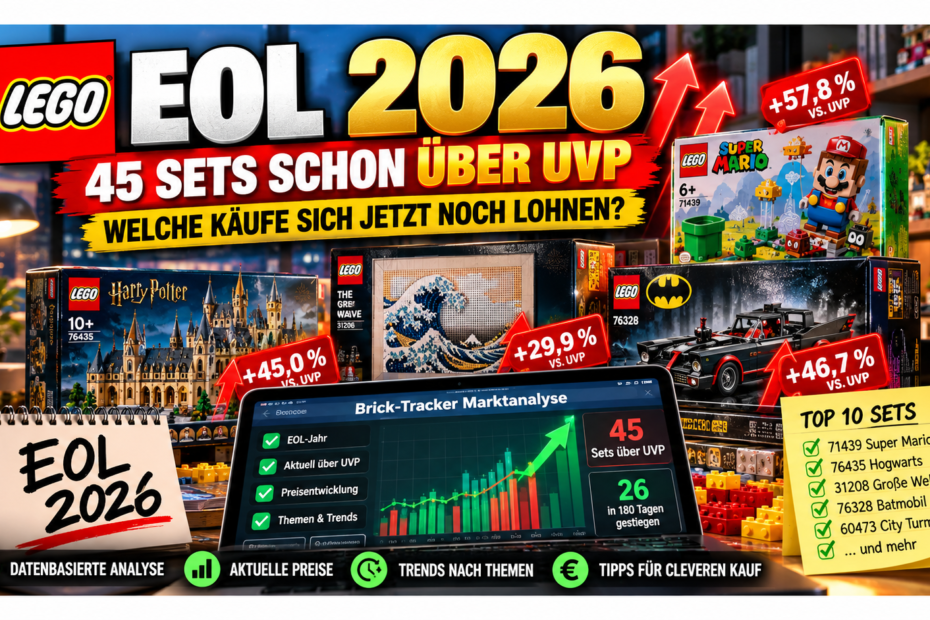
LEGO EOL 2026: Which sets have already become expensive, which themes are gaining popularity—and when is the right time to buy? A look at the Brick-Tracker market analysis reveals that, in a recent dataset filtered by “EOL 2026” and “Currently Above MSRP,” 45 sets are listed. Of these, 26 have increased in price over the last 180 days. This is exciting news for collectors—but it’s also a warning for buyers: If you wait too long to buy, you might end up paying significantly more than necessary.
Data as of: October 16, 2026; snapshot provided by Brick-Tracker market analysis. Retailer prices and EOL classifications are subject to change. EOL 2026 refers to the assigned or projected end-of-life year, not necessarily an end of production that has already occurred.
45 LEGO Sets Above MSRP—What That Number Really Means
The number is impressive, but it must be interpreted correctly. The market analysis was set to an EOL year of 2026, 180 days, and current MSRP. Therefore, the 45 results do not indicate how many sets will be retired in 2026, nor do they prove that all sets are already sold out. It is a targeted selection of products whose lowest currently recorded retailer price is above the manufacturer’s suggested retail price.
The 26 sets showing price increases also refer to this exact filtered group. The comparison shows which prices have changed over the past six months; it does not yet explain why. Declining retailer availability, special promotions, short-term price spikes, and changes in the product lineup can all play a role.
The EOL Ranking: These Ten Regular Sets Stand Out
The following selection includes standard LEGO sets from the provided data extract and is sorted by price change over 180 days. Polybags, promotional items, educational products, and notable older set entries have been intentionally excluded from this ranking. The historical best price should not be confused with today’s retailer price.
| Set | Topic | Current Price | MSRP | About MSRP | 180 days | All-time low price |
|---|---|---|---|---|---|---|
| 71439 Adventures with the Interactive LEGO Mario |
Super Mario | 78.90 € | €49.99 | +57,8 % | +132,1 % | €44.90 |
| 76435 Hogwarts Castle: The Great Hall |
Harry Potter | €289.99 | 199.99 € | +45,0 % | +100,0 % | 144.99 € |
| 31208 Hokusai – The Great Wave |
Type | 129.86 € | 99.99 € | +29,9 % | +85,5 % | 59.86 € |
| 11043 Cool Creative Set |
Classic | 46.05 € | 29.99 € | +53,6 % | +70,6 % | 19.05 € |
| 76328 Batman: Batmobile from the 1960s TV series |
Super Heroes | €219.99 | 149.99 € | +46,7 % | +56,0 % | 78.99 € |
| 31157 Exotic Peacock |
Creator 3-in-1 | 27.95 € | €19.99 | +39,8 % | +47,1 % | €8.95 |
| 60368 Arctic research vessel |
City | €159.95 | 149.99 € | +6,6 % | +45,4 % | €49.95 |
| 60473 The City Tower |
City | 278.00 € | €199.99 | +39,0 % | +41,8 % | 82.00 € |
| 60467 Heavy-duty tow truck with crane |
City | 99.95 € | 79.99 € | +25,0 % | +35,1 % | 25.95 € |
| 76417 Gringotts Wizard Bank – Collector’s Edition |
Harry Potter | 539.99 € | €429.99 | +25,6 % | +27,4 % | 115.99 € |
Source of figures: Brick-Tracker data provided by the operator. Prices are snapshots and do not represent achievable resale proceeds. Amazon prices are not included in the Brick-Tracker Price History.
Four examples illustrate why the purchase price is crucial
LEGO Super Mario 71439: +132.1% in 180 days
The interactive LEGO Mario set is currently priced at 78.90 euros—compared to a MSRP of 49.99 euros. The all-time low price is 44.90 euros. This significant difference shows just how much the current sale price can vary from previous purchase opportunities. Someone who buys the set now for 78.90 euros does not automatically have the same investment opportunity as someone who purchased it at a significantly lower price.
LEGO Harry Potter 76435: The Great Hall—significantly above the MSRP
The Great Hall of Hogwarts is listed at 289.99 euros, with an MSRP of 199.99 euros and a historical best price of 144.99 euros. The price increase over 180 days, according to the data extract, is 100 percent. Especially with large Harry Potter sets, it’s therefore worth checking historical low prices, available Sellers, and the actual status of the product’s discontinuation separately.
LEGO Art 31208: Hokusai’s Great Wave
For Hokusai’s “The Great Wave,” the current price of 129.86 euros contrasts with the MSRP of 99.99 euros and a previous best price of 59.86 euros. This example shows that even a decorative set outside the realm of traditional licensed themes can experience significant price fluctuations. However, this does not allow for a blanket statement about all LEGO Art sets.
LEGO Batman 76328: Significant price gap compared to the previous low
The Batmobile from the 1960s TV series is on sale for 219.99 euros; its MSRP is 149.99 euros. The all-time low price of 78.99 euros makes it particularly clear why the discount at the time of purchase can play a bigger role than the subsequent headline “above MSRP.”
Why “MSRP” Doesn’t Automatically Mean “Good Investment”
A current seller’s price is, at first, merely a listed price. Whether a set can actually be sold for that amount depends on demand, condition, packaging, platform, fees, shipping, and competing deals. Even the historical low price does not mean that every buyer purchased the item at that price.
Furthermore, comparing prices to the MSRP can be misleading. A set with a 40 percent price increase over its MSRP may not be financially attractive to a buyer due to its high starting price. Conversely, a set may still be priced below the MSRP and yet still offer a decent margin compared to a particularly low purchase price.
The 35-to-38-Percent Rule: How Brick-Tracker Rates Purchase Prices
For my own LEGO purchasing strategy, I prefer to look for Deals offering a discount of about 35 to 38 percent off the MSRP —and for the right sets, I’ll even look for significantly deeper discounts. This range is not a scientifically proven guarantee of profit, nor is it a universal minimum threshold. It serves as a practical starting point for creating a buffer when making purchases to account for future price fluctuations, fees, and extended storage periods.
Here’s an example: With a MSRP of 199.99 euros, a 35 percent discount would result in a purchase price of about 129.99 euros, while a 38 percent discount would result in a purchase price of about 123.99 euros. If the final gross selling price were 200 euros, the difference would still be far from the profit: sales fees, shipping, taxes, storage, and potential returns must be taken into account. Especially for commercial sellers, it’s also important to distinguish between net and gross prices.
How to Make Better Decisions Using Market Analysis
- Select EOL Year: Start with 2026 in the LEGO Market Analysis. Then switch to 2025, 2024, and earlier years to compare historical trends.
- Filter by “Above MSRP ” or “Below MSRP”: “Above MSRP” shows today’s notable price levels. For new purchases, sets priced below MSRP are often more attractive—provided that demand and Price History align.
- Change the time period: Compare 14, 30, 90, 180, and 365 days. A short-term fluctuation is different from a trend over many months.
- Narrow down themes and price ranges: Harry Potter, City, Super Mario, and LEGO Art sets can vary greatly. Filters for theme, MSRP price range, current retailer prices, and number of pieces help you compare similar sets.
- Check individual price charts: A ranking alone isn’t enough. Open the Price History and look for historical lows, price spikes, and the number of sellers.
- Only buy when the price is right: Take advantage of Top Deals, Live Deals, and Price Alerts through the Brick-Tracker app.
Backtracking: What Past EOL Years Can Reveal
One of the most useful features is the “Look Back” function. By selecting the EOL year 2025, 2024, or earlier years in the market analysis, users can examine which items are currently priced above their MSRP, which are still below it, and how prices have fluctuated over various time periods. This allows you to test hypotheses: Do major license sets trend differently than LEGO City? Do collector’s models take longer to gain traction? Which sets have dropped in price again after initial price spikes?
It is important not to treat a single success story as the norm. A reliable assessment requires both winners and losers, comparable time periods, and as many data sets as possible. Market analysis helps identify patterns; it is not a substitute for a forecast and does not guarantee a return.
Black Friday isn’t a must-attend event: You can find great LEGO deals all year round
From my daily monitoring of the market, I see time and again that major sellers undercut each other, discount codes pop up, and promotions trigger new rock-bottom prices on short notice. My impression, therefore, is that it feels like there’s a new wave of major deals about every six weeks. This is a personal observation, not a statistically proven fixed six-week rule.
Even a week before Black Friday, some LEGO sets may already be priced very attractively. That’s why I would never wait exclusively for a specific calendar day. What matters most is the Price History of the specific set: Is the deal close to the best price so far, or even lower? How many sellers still carry it? Is it actually nearing EOL? And does it even fit with your own Collection or sales strategy?
If you don’t want to browse through the Sellers’ sites yourself every day, you’ll find new Deals all the time in the Live Deals section and can keep an eye on sets that interest you using the Brick-Tracker app.
Which sets would I still buy—and which ones wouldn’t I?
If I were buying for investment purposes, I would be particularly cautious with sets that are already significantly above the MSRP. The potential price increase is already factored into the current selling price, at least in part. That doesn’t mean such sets can never go up in price again; it simply means that the margin of safety when purchasing them has narrowed.
I find sets more interesting if they are still readily available, have a convincing historical Price History, and can be purchased at a significant discount. For each candidate, I also evaluate demand, theme, inventory needs, capital tied up, and a realistic future selling price.
Conclusion: It’s not the EOL list alone that matters—it’s the right price.
The 45 results from the EOL-2026 filter that are already above the MSRP show why it’s worth monitoring prices early on. However, the most important conclusion is not to “buy every EOL set,” but rather the exact opposite: shop selectively, compare Price Histories, and avoid buying at prices that are too high.
For a complete overview of sets scheduled for discontinuation, check out our 2026 LEGO EOL list. To give ratings to individual sets, it’s worth taking a look at the Brick-Tracker market analysis. If you want to organize your purchases, inventory, and potential value trends, you can also use the Investment Tool.
Frequently Asked Questions About LEGO EOL 2026
What does EOL mean at LEGO?
EOL stands for “End of Life” and refers to the planned or actual discontinuation of a set. An EOL year listed in a list is not automatically an officially confirmed discontinuation date.
Do LEGO sets always increase in value after EOL?
No. Some sets go up in value, while others remain the same or go down. The eventual sale price depends on demand, supply, condition, and many other factors.
Does a LEGO set automatically sell out if it’s priced above the MSRP?
No. A price above the MSRP simply means, for now, that the lowest retailer price currently recorded is higher. Whether and where the set is still available must be checked separately.
How much should the discount be before EOL?
There is no one-size-fits-all figure. Brick-Tracker often bases its purchasing strategy on a discount of 35 to 38 percent, but evaluates each set based on its history, demand, and potential margin.
How can I compare older EOL years?
In the market analysis, you can change the EOL year and examine price movements across different time periods, topics, and price ranges.
Note: This article presents market observations and personal shopping considerations; it is not investment advice. Figures are snapshots and are subject to change.