

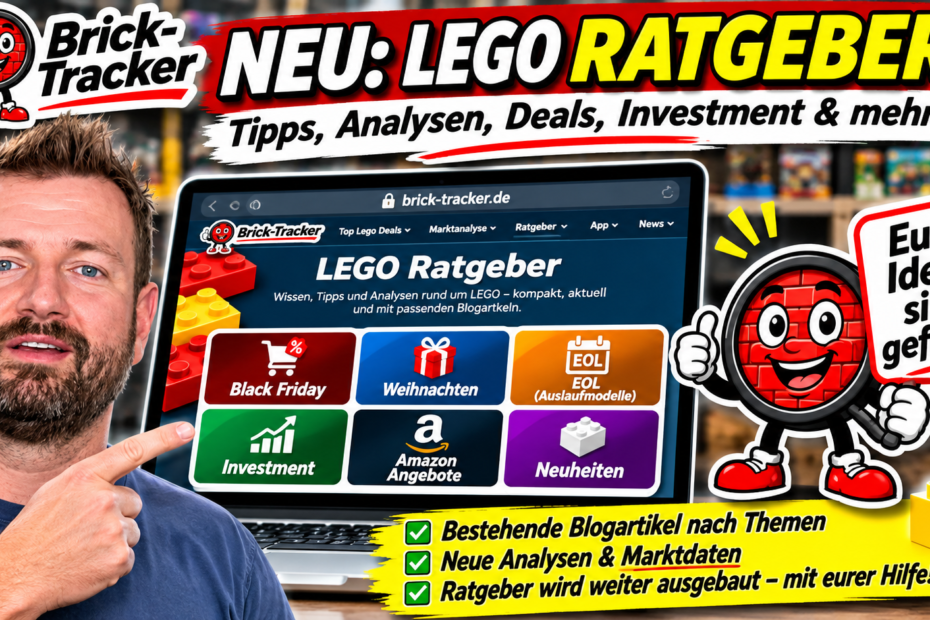
New LEGO Guide on Brick-Tracker: Our News Has a Permanent Home
So, there’s been quite a bit going on at Brick-Tracker over the past few days. We already have our Price Comparison tool, live deals, market analysis, and, of course, the blog, where we regularly post the latest LEGO news, reviews, and Deals. Now we’re adding another building block: our new LEGO guide.
And before anyone thinks we just wrote six new pages and that’s it: that’s not really what this is about. The idea is to take all the information that’s accumulated on the blog over time and organize it sensibly by topic. That way, articles won’t disappear into the news archive after just a few days, even though they might still be interesting to someone months later.
You can check out the new LEGO guide right here.
Why another guide at all when there’s already a blog?
That’s a perfectly valid question. Of course, our LEGO blog will continue to be available. There you’ll find the latest news, new sets, retailer promotions, reviews, and everything else that’s happening right now. But a blog like that is organized chronologically: What’s new today will slide down the page in a few days.
For example, if you’re looking into LEGO investments in November, you might be interested in more than just this week’s news. You might want to know how older EOL sets have performed, which sets are being discontinued, or how to determine a reasonable purchase price in the first place. This kind of information is often scattered across different posts.
This is exactly where the new guide comes in. Each topic page offers a clear starting point and highlights related blog posts. So the content isn’t simply copied; instead, it’s organized by topic. And when new relevant posts are published, they can reappear in the corresponding topic overview.
In other words: The blog provides the latest news, while the guide organizes it into a knowledge base that’s easier to navigate. And anyone who wants to dive deeper will be taken directly to the relevant tools on Brick-Tracker.
We’re kicking things off with these six LEGO themes
To start with, we’ve set up six sections. We’ve made them intentionally different, because someone looking for a Christmas gift naturally has different questions than someone who wants to store LEGO sets for several years.
- LEGO Black Friday – Which discounts are really worth checking out, how do you compare Deals, and when is it worth waiting for a sale?
- LEGO Christmas – Gift ideas, price tracking, and the question of whether it’s better to buy LEGO gifts early or just before Christmas.
- LEGO EOL – What does “End of Life” mean, which model years are priced above the MSRP, and what happens after production ends?
- LEGO Investment – Purchase prices, potential returns, risks, and a look at actual market data.
- LEGO Amazon Deals – How good are these supposed bargains really, when you factor in other sellers as well?
- New LEGO Products – New sets, announcements, and the ability to track their prices after release.
That’s our starting point for now. But I believe we can do much more with it over time.
For example: From an EOL news item to a real market overview
Let’s take the topic of LEGO EOL, for example. There are always individual reports on this: a set is set to be discontinued, a list is being updated, or we’re looking at how the prices of certain models are changing.
On the LEGO EOL guide page, you can now find all this information in one place. And we’ve even gone a step further: We display data directly from our own database there.
Currently, for several EOL vintages, it’s possible to track how many recorded sets with an available retailer price are above or below their original MSRP. The analysis is updated regularly. This allows you to see, for example, how differently newer and older vintages are performing at the moment.
Of course, it’s important to note that a retailer price above the MSRP does not necessarily reflect an actual selling price or a guaranteed return on investment. However, the figures help put trends into perspective rather than simply assuming that everything becomes more expensive after EOL anyway.
If you’d like even more detailed information, you can go directly from there to the LEGO Market Analysis and examine individual model years or price trends in greater detail.
The articles are not duplicated but are newly indexed.
That’s what’s particularly important to me about this whole thing. We don’t want to publish ten nearly identical articles on every topic. Instead, we want existing posts to remain useful.
For example, an article about a new LEGO Star Wars release remains a news item. However, if it’s also relevant to the “New Releases” section, it can also appear there. A post about a major Amazon promotion, on the other hand, fits into the “Deals” section. And an analysis of price increases naturally belongs in the “EOL” or “Investment” section.
Over time, this results in topic overviews that consist not only of general explanations but also of specific examples, current news, and older posts that remain relevant. For you, this means one thing above all: less searching and faster access to the right topic.
And what about Price Comparison? Of course, that’s part of it.
If you come across an interesting LEGO set in an article, the process of conducting a Price Comparison should be as quick and easy as possible. After all, what good is a great set review if I then have to search five sellers myself to find the best price?
That’s why the LEGO Price Comparison, our live deals, and market analysis remain the foundation. The guides help you make sense of it all; the tools provide the specific data and deals.
You can find your Wishlist, Price Alerts, the app, and other features as usual via our central Brick-Tracker overview.
Now it’s your turn: Which LEGO guides are you missing?
And that brings us to the point where I’d really love to hear your thoughts. What topics should we cover next in our guide? I have a few ideas, but ultimately, this section is meant to answer the questions that you’re actually wondering about.
I do have a few ideas:
- LEGO Star Wars as an Investment: What makes this theme line special, and what should you look out for when it comes to EOL products and purchase prices?
- LEGO for Beginners: How does our Price Comparison work, how do you set up a Price Alert, and what actually counts as a good discount?
- Selling LEGO Sets: How can you realistically estimate prices, and what costs should you factor in when reselling?
- Understanding LEGO price trends: What do MSRP, best price, and historical Price Histories actually tell us?
- Managing LEGO Collections: How do you keep track of your own sets, purchase prices, and current market values?
These are, for now, just suggestions—not finished guides. Maybe you have some completely different ideas. I’d be particularly interested in topics where you keep asking the same questions or where you’re missing a clear overview.
Feel free to share your requests in the comments below. If there’s a specific statistic from our database you’d like to see, please let us know. I’ll then see what we can realistically implement.
My conclusion: Another building block for Brick-Tracker
So, for me, the new LEGO guide isn’t just another section. I want Brick-Tracker to gradually become a go-to resource where you can not only find the best LEGO prices, but also background information, real-world experiences, and actual data.
The blog is here for the latest news. The guides organize knowledge by topic. And our tools help you apply that information directly to individual LEGO sets.
The whole thing will certainly continue to grow, and we’ll make some improvements here and there. But I think we’re heading in the right direction.
Here’s an overview of all six LEGO guides.
And now I’m really curious: Which guide would you like to see next?