

Hi there!
Today we’re taking a look at something truly special—and probably one of the oldest LEGO sets I’ve shown you here on the blog so far.
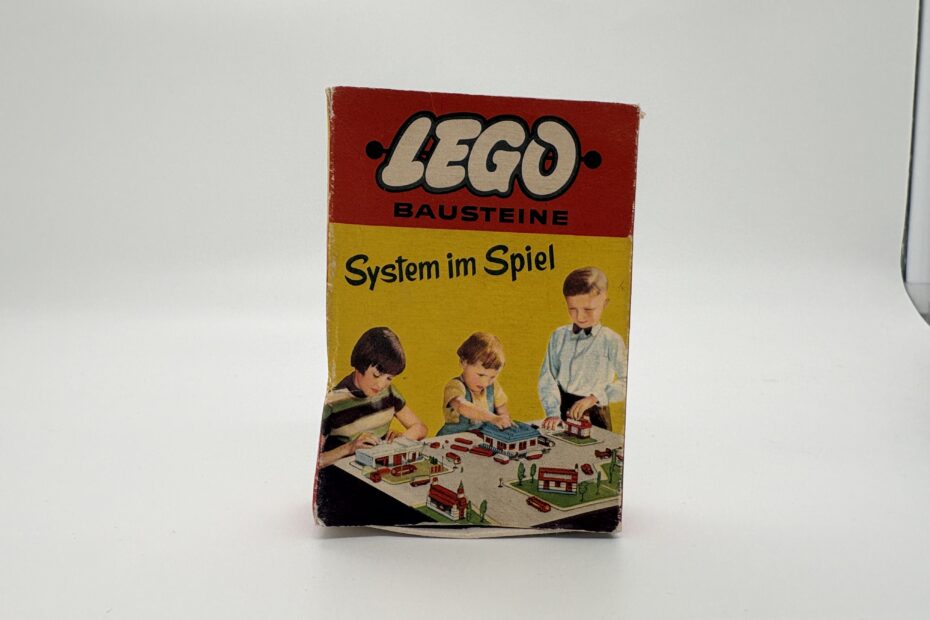
It’s the LEGO System in Play Set 217, a small building block set from 1958.
No Minifigures, no license, no elaborate building instructions—just five LEGO bricks.
And yet I find this little set incredibly exciting, because it lets us take a look back at a time when the LEGO brick, as we know it today, had only just been created.
Let’s get started!
LEGO 217 – Five Cornerstones for Free-Form Building
In 1958, various small expansion sets containing individual LEGO bricks were released. They were intended to help children expand their existing models and, of course, above all, to let them get creative on their own.
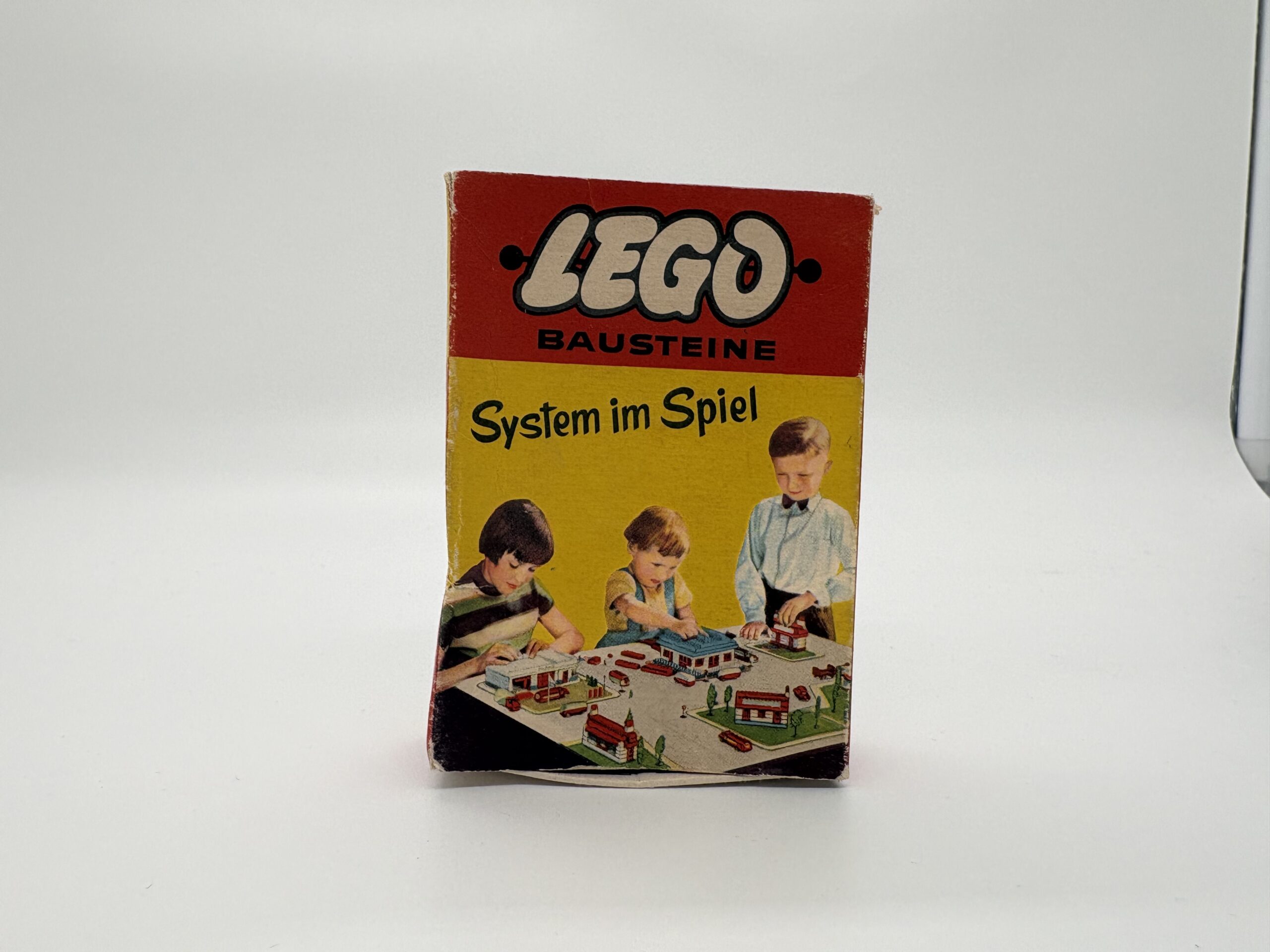
One of them was set 217—4 x 4 Corner Bricks.
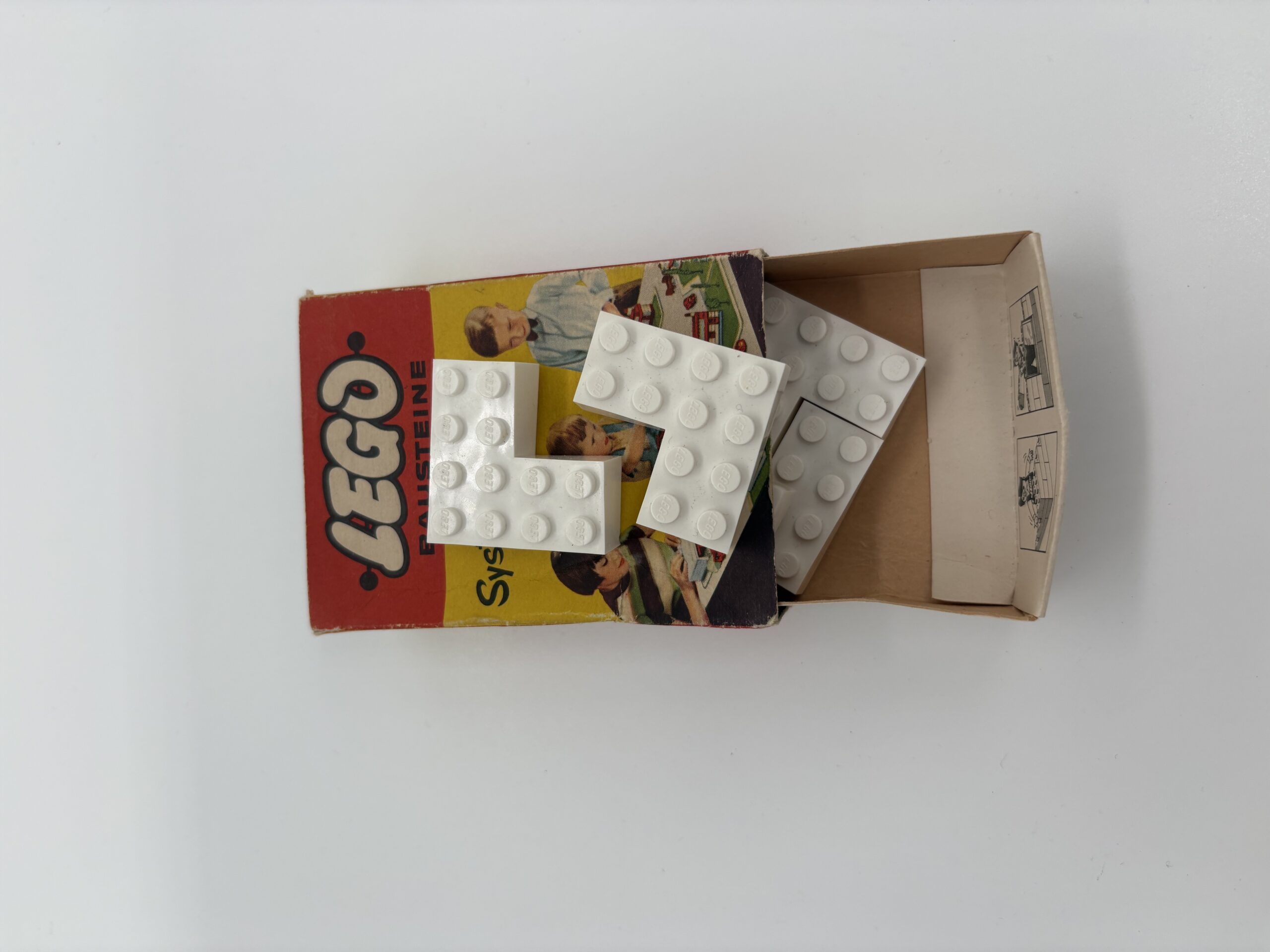
The European version contains just five corner bricks inthe small box. Each of these L-shaped bricks has a total of twelve studs.
What’s interesting is that set number 217 wasn’t simply assigned to a specific color.
Among other things, the box could contain corner pieces in white, red, yellow, blue, black, or even clear . The set number remained the same, however.
Something like that is unimaginable these days. My copy contains five white corner pieces.
For me, the packaging alone is a highlight
Before we even get to the stones, it’s worth taking a look at this little box.
The design is simply wonderfully nostalgic.
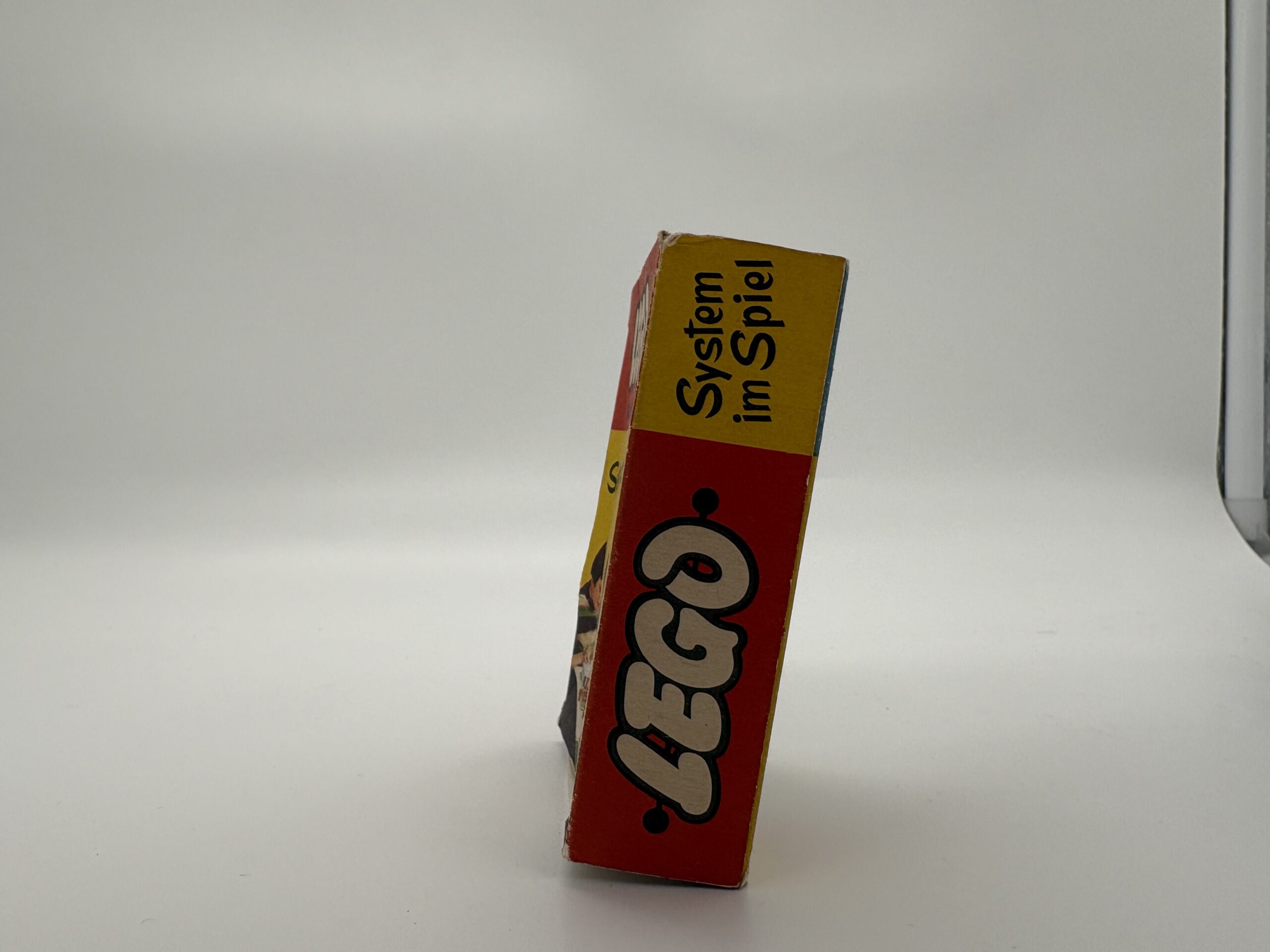
On the front, we see children building a small LEGO town together, along with the old LEGO branding and, of course, the slogan from back then: “System in Play”
Even back then, red—or red combined with yellow—played a major role in the LEGO logo—even though the logo, of course, looked quite different from how it does today.
By the way, the children featured on many of those old packages weren’t just any models.
They were Hanne, Gunhild, and Kjeld Kirk Kristiansen—the three children of Godtfred Kirk Christiansen and, therefore, the grandchildren of LEGO founder Ole Kirk Christiansen. All three appeared on various LEGO packages in the 1950s.
It’s precisely these little details that make these old packages incredibly interesting to me.
“Toys for All Ages”
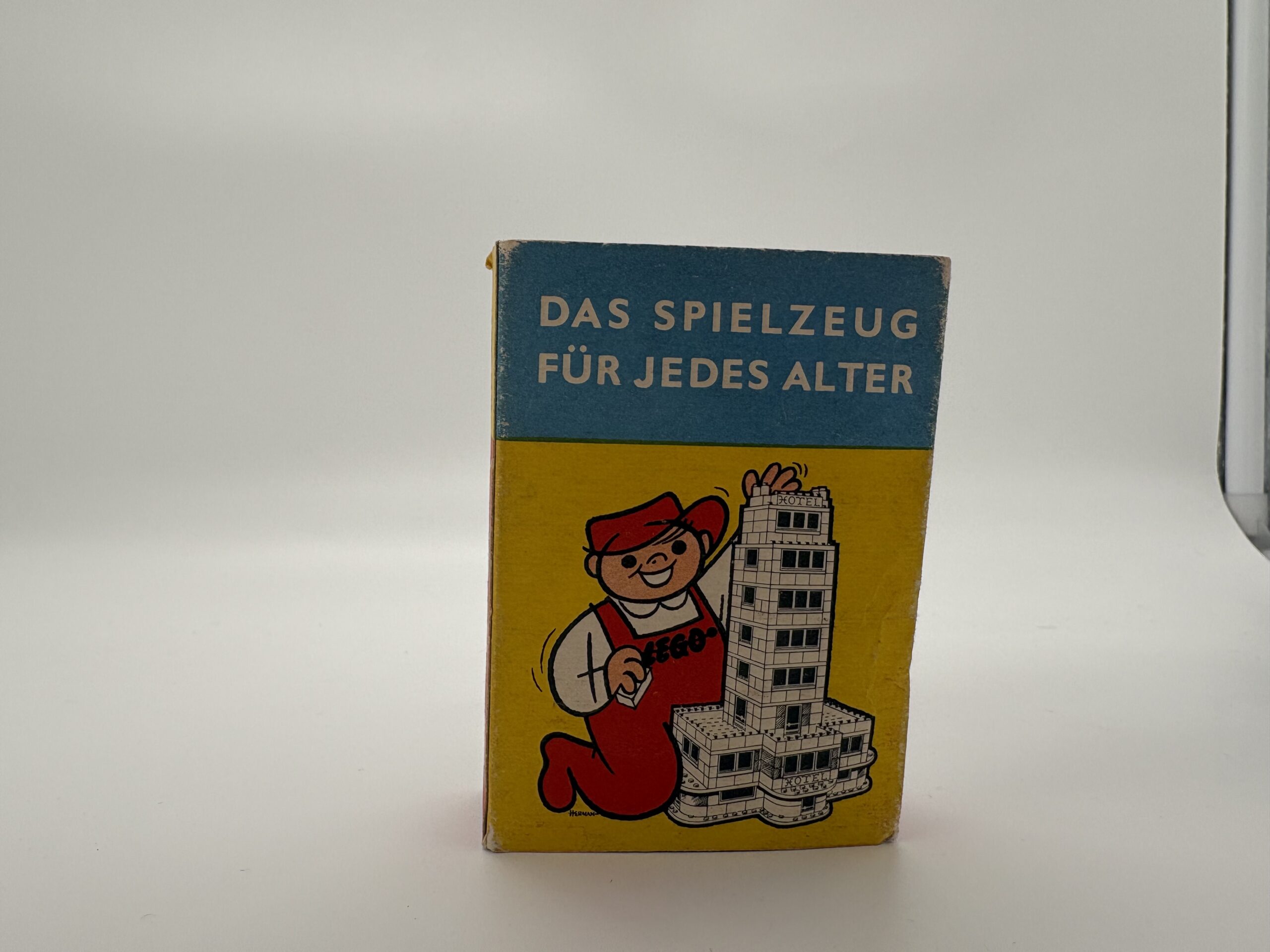
The rest of the packaging design is also quite appealing. The classic LEGO branding continues along the sides, and on the back and other surfaces, you can see small, hand-drawn LEGO figures building things. It also features the lovely old slogan: “Toys for all ages.”
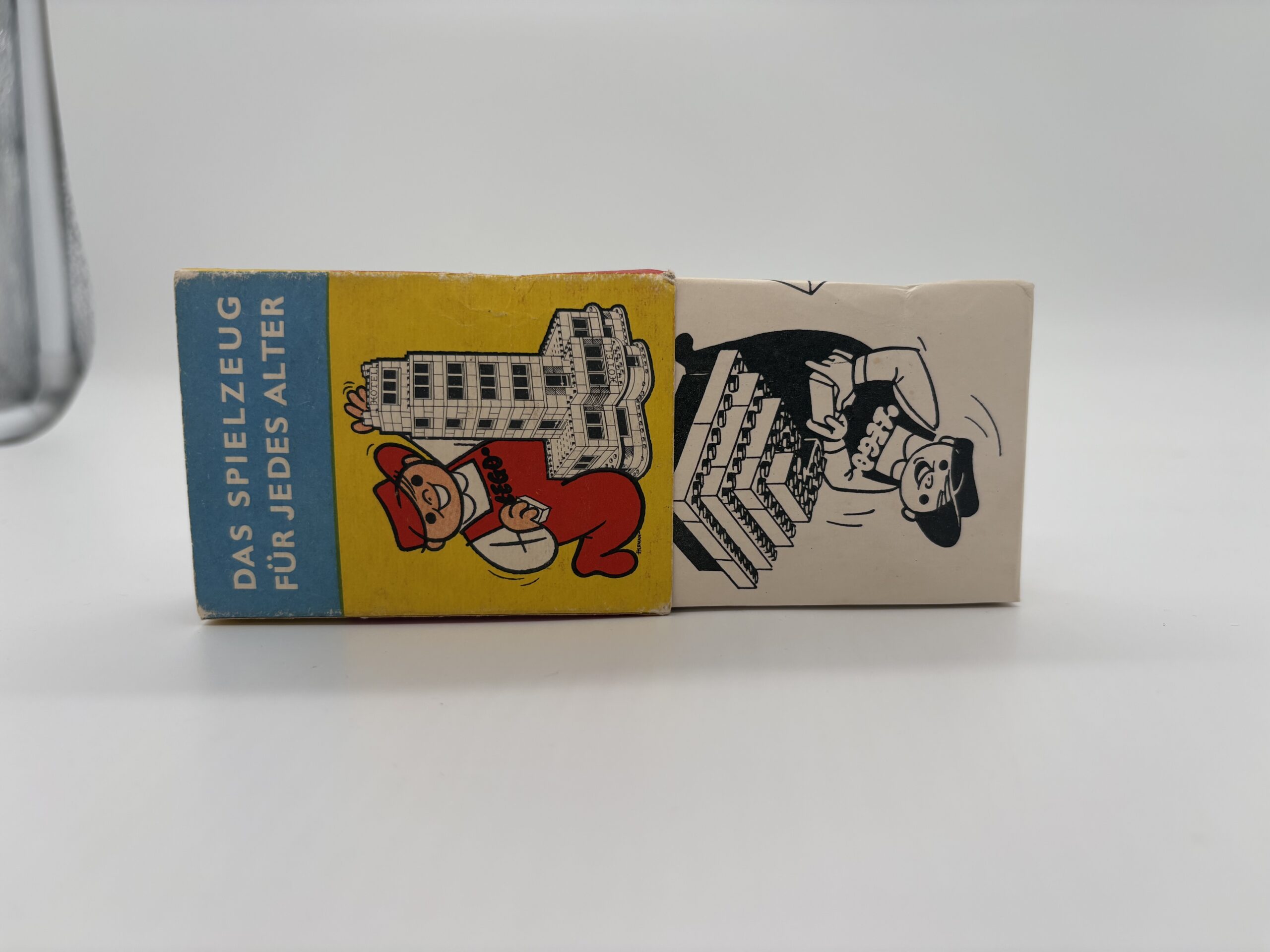
Among other things, a large hotel—or building—is being constructed, and these little cartoon-like figures are everywhere.
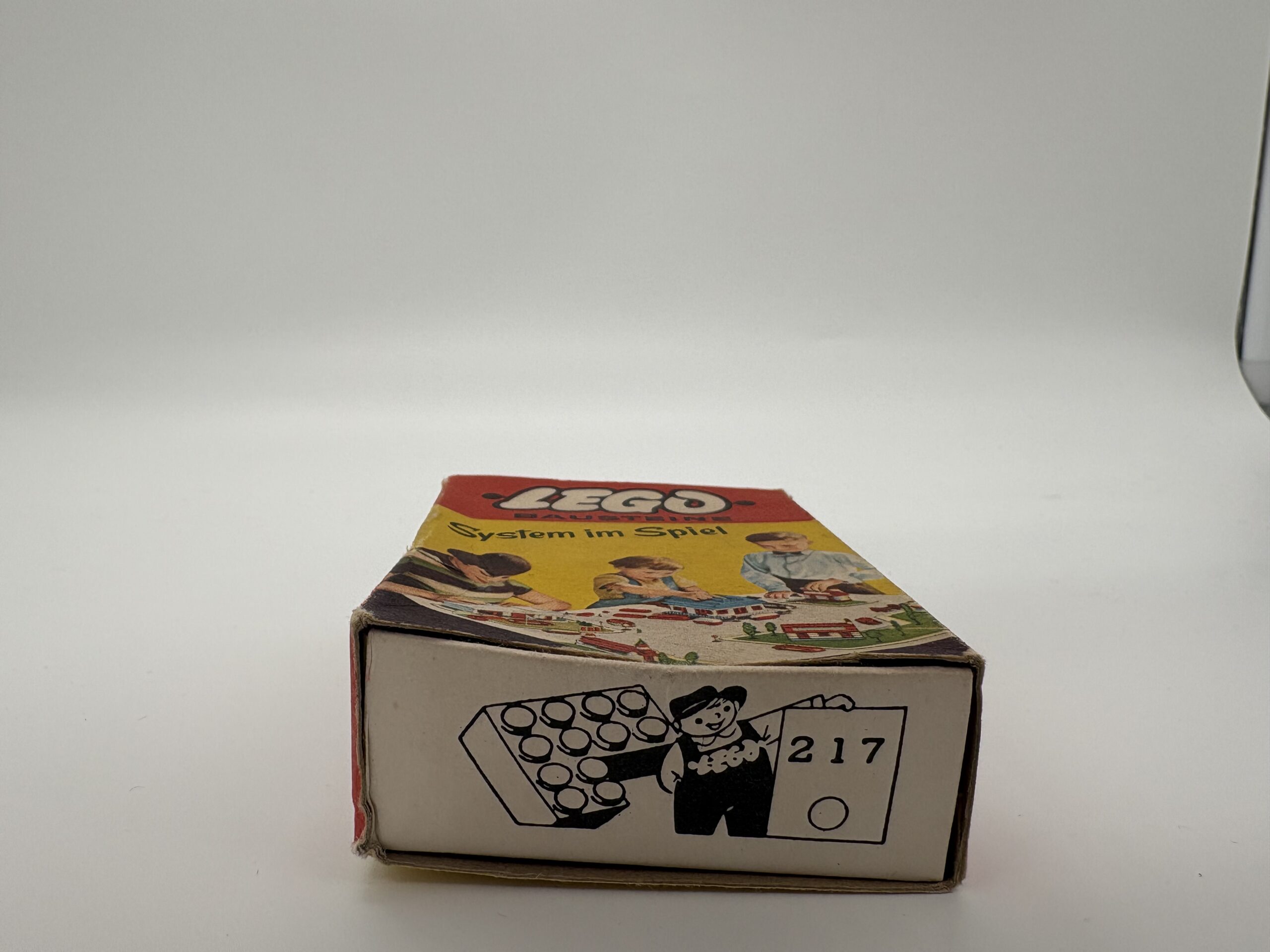
On the front and back sides, you’ll also find the illustration of the cornerstone again—and, of course, the number 217 in large print.
Today, probably no one would go to such lengths to package five individual, identical stones in such an elaborate way.
But that’s exactly what makes the box so charming.
A really small sliding box
The packaging itself works like a small drawer.
You simply pull the inner box out of the outer sleeve, and inside are the five cornerstones. And the design doesn’t stop there—it continues inside as well.
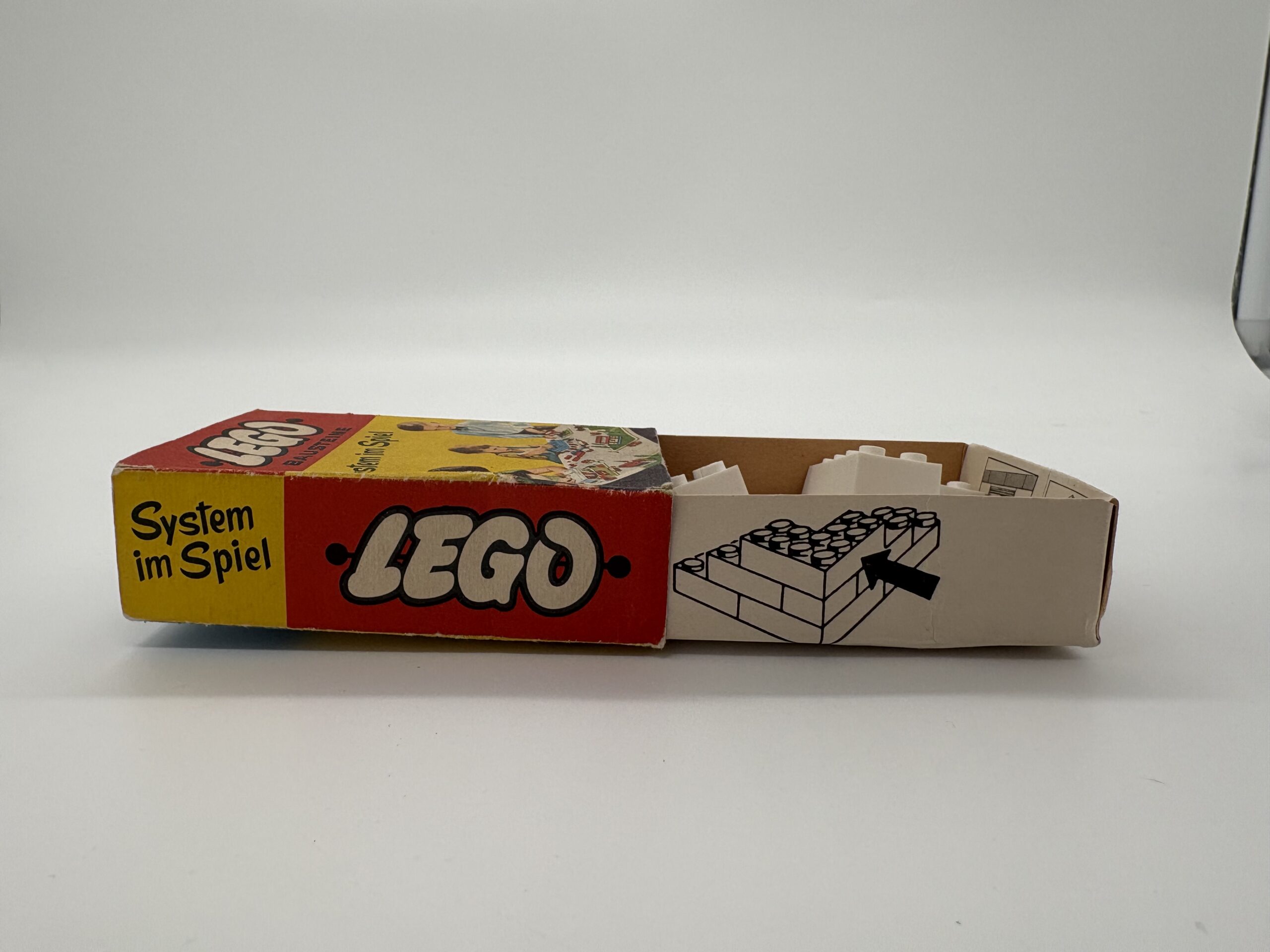
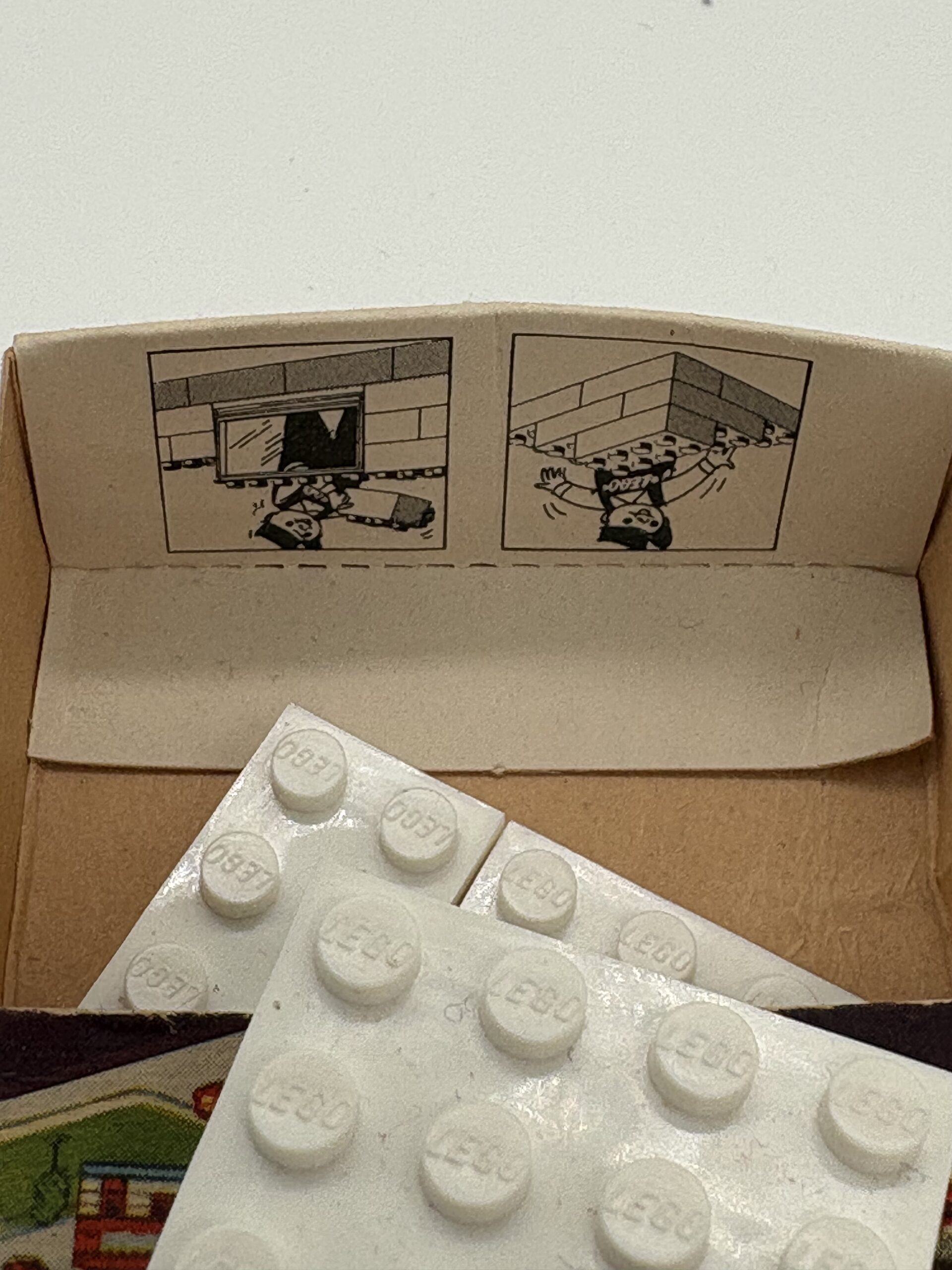
The little LEGO cartoon characters appear again on the edge and inside the packaging.
The bottom of the box even shows what you can build with these bricks—for example, a small pyramid-like structure.
There’s also a brief explanation of how the bricks are put together.
Of course, that seems obvious today. But back in 1958, it was a completely different story.
And then five practically unused LEGO bricks turn up
The craziest thing about my set, to me, is what’s inside. When you pull out the little box, five nearly unused white corner bricks actually appear.
And we’re talking about bricks that are now almost 70 years old.
You can also clearly see the old LEGO branding on the studs.
However, the bricks no longer look 100 percent straight.
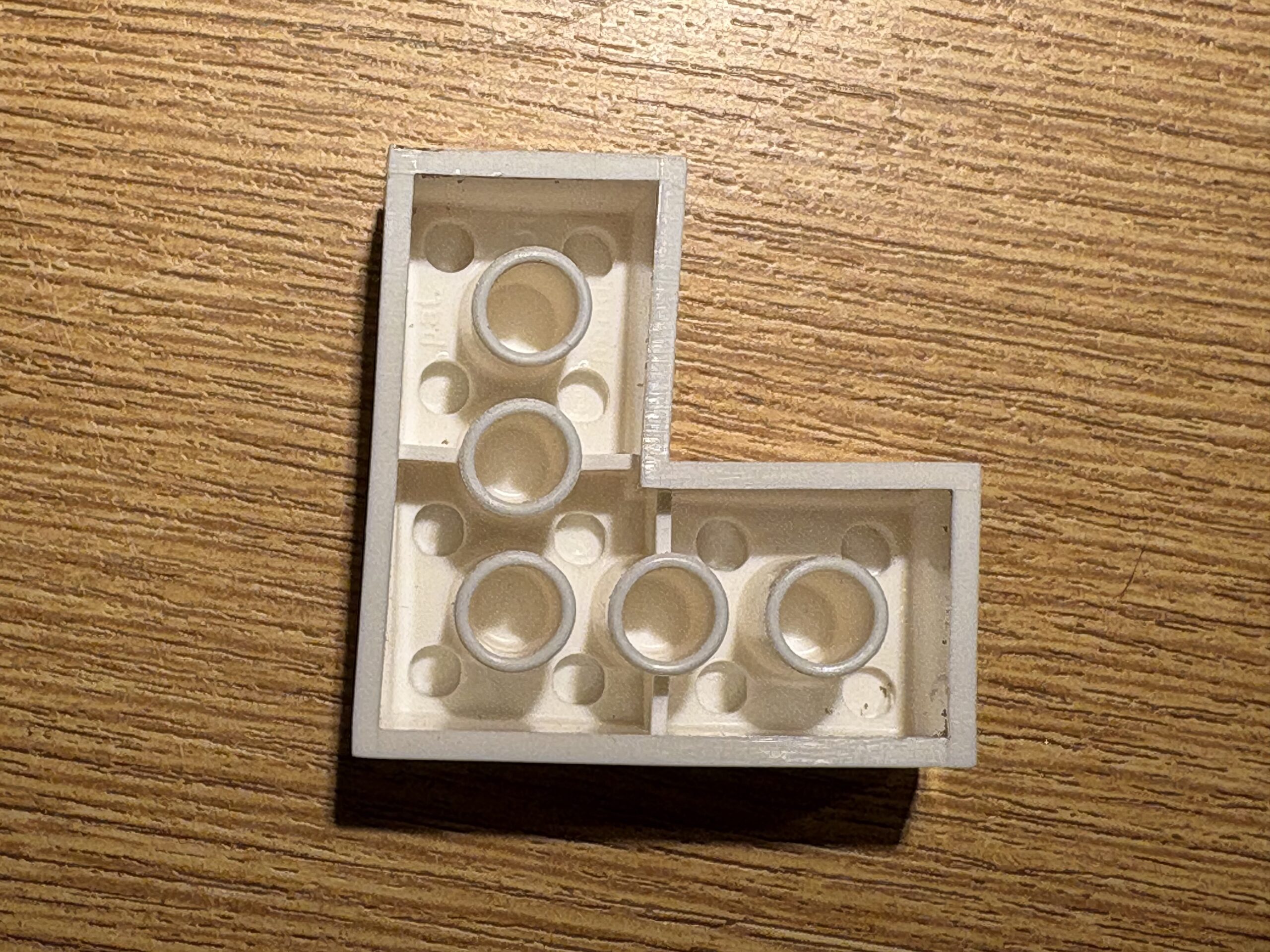
Even though they’re practically unused, the plastic has warped slightly over the decades. As a result, some of the edges look a little crooked.
And it’s exactly these kinds of things that I find particularly fascinating about old LEGO pieces.
You’re not just holding any old white brick in your hand—you’re holding a piece of material and manufacturing history.
Right from the time when today’s LEGO brick was created
And it is precisely the year 1958 that makes this set particularly interesting.
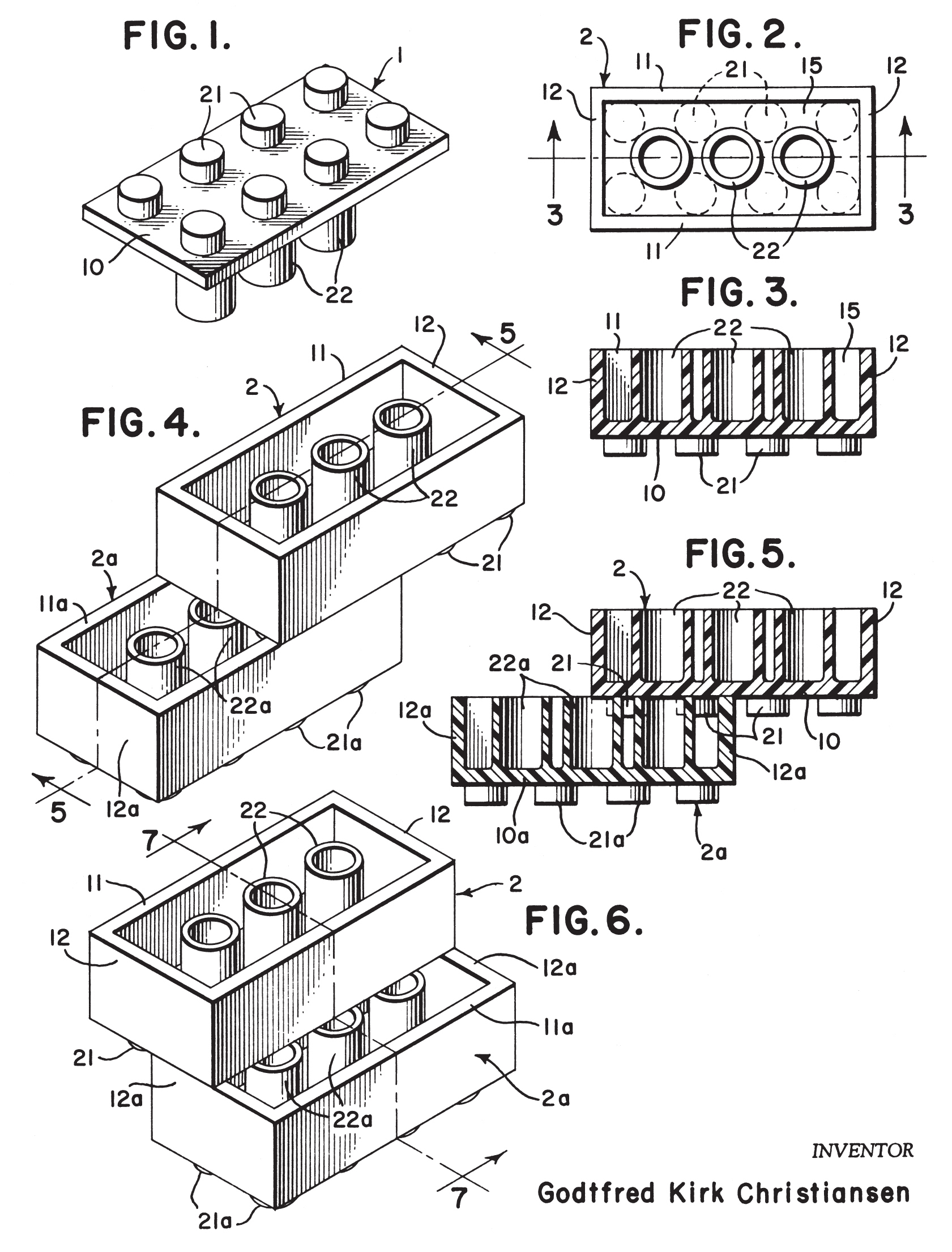
Until then, LEGO bricks were essentially hollow on the underside. However, this meant that built models did not hold together very well.
Godtfred Kirk Christiansen therefore developed the “stud-and-tube” principle —now widely recognized—with the tubes on the underside.
On January 28, 1958, at 1:58 p.m., LEGO filed a patent application for this principle. It was precisely this combination of studs on top and tubes on the bottom that created the interlocking force that still characterizes the LEGO brick today.
And you can see exactly these tubes in the corner bricks from my box.
So if you turn one of these bricks over today, the basic principle looks surprisingly familiar.
Nearly 70 years later, LEGO still functions at its core according to exactly this idea.
For ten euros, I couldn’t say no
I found this little set at Lars Conrad’s—better known as “The Toy Investor”—in his LEGO store, Bardobrick, in Bardowick.
Lars is well known for always managing to track down older, rarer, or just plain quirky LEGO items.
And when I saw that little box over there for about 10 euros, I just had to take it home. For me, it was an absolute no-brainer.
Of course, you can tell the box is getting on in years.
The front is slightly dented, the sliding box doesn’t open quite as smoothly as it used to, and there are a few general signs of wear. But honestly: this thing is from 1958.
Considering that, I still think it’s in really charming condition.
My oldest LEGO set
And so the little 217 is now actually my oldest complete LEGO set.
While I do own individual LEGO bricks and pieces that also date back to very early times, no other complete set in my Collection is older.
And I’m actually pretty happy about that.
The prices of these small, old expansion sets vary widely.
Depending on the color, the condition of the box, whether the set is complete, and the condition of the bricks, you can sometimes find them for between 10 and 25 euros; special editions can, of course, cost more than that.
But for me, it’s less about the current value anyway.
To me, it’s simply a little piece of LEGO history.
Rare & Quirky Things—There Will Be More of Them in the Future
And that’s exactly why I’d like to feature things like this more often here on the blog in the future.
Under the heading “Rare & Quirky,” we’ll be taking a look at unusual items from my Collection from time to time.
These can be very old LEGO sets like this one, but they can just as easily be rare Minifigures, unusual individual pieces, promotional materials, giveaways, or any other items from LEGO’s past that might make you say today , “What on earth is that?”
Some of these will be decades old, while others might be just a few years old.
But as a collector, I find exactly these kinds of things incredibly exciting, and I’d like to show you a lot more of them in the future.
My Conclusion
Of course, the LEGO System in Play 217 isn’t a set you’d buy today for its great building experience.
It consists of five white corner bricks.
That’s it.
And yet I find this little box incredibly fascinating.
The vintage packaging, the illustrations, the sliding box, the historic LEGO branding, and then these five vintage bricks from the very era when the stud-and-tube system was created—to me, this is simply a beautiful little piece of LEGO history.
And for ten euros, I’m all the more delighted that this set has now found a place in my Collection.
Now it’s your turn: Do you own any really old LEGO sets like this?
What’s the oldest model in your Collection, and do you find these little historical curiosities just as exciting as I do?
Feel free to write anything in the comments!
For the best LEGO Price Comparison, check out Brick-Tracker: LEGO® Price Comparison, Top Deals & Marketplace | Brick-Tracker
Author: Dante